Fast Delivery
Delivery of products nationwide with proper coordination for fast and reliable order fulfillment.
→

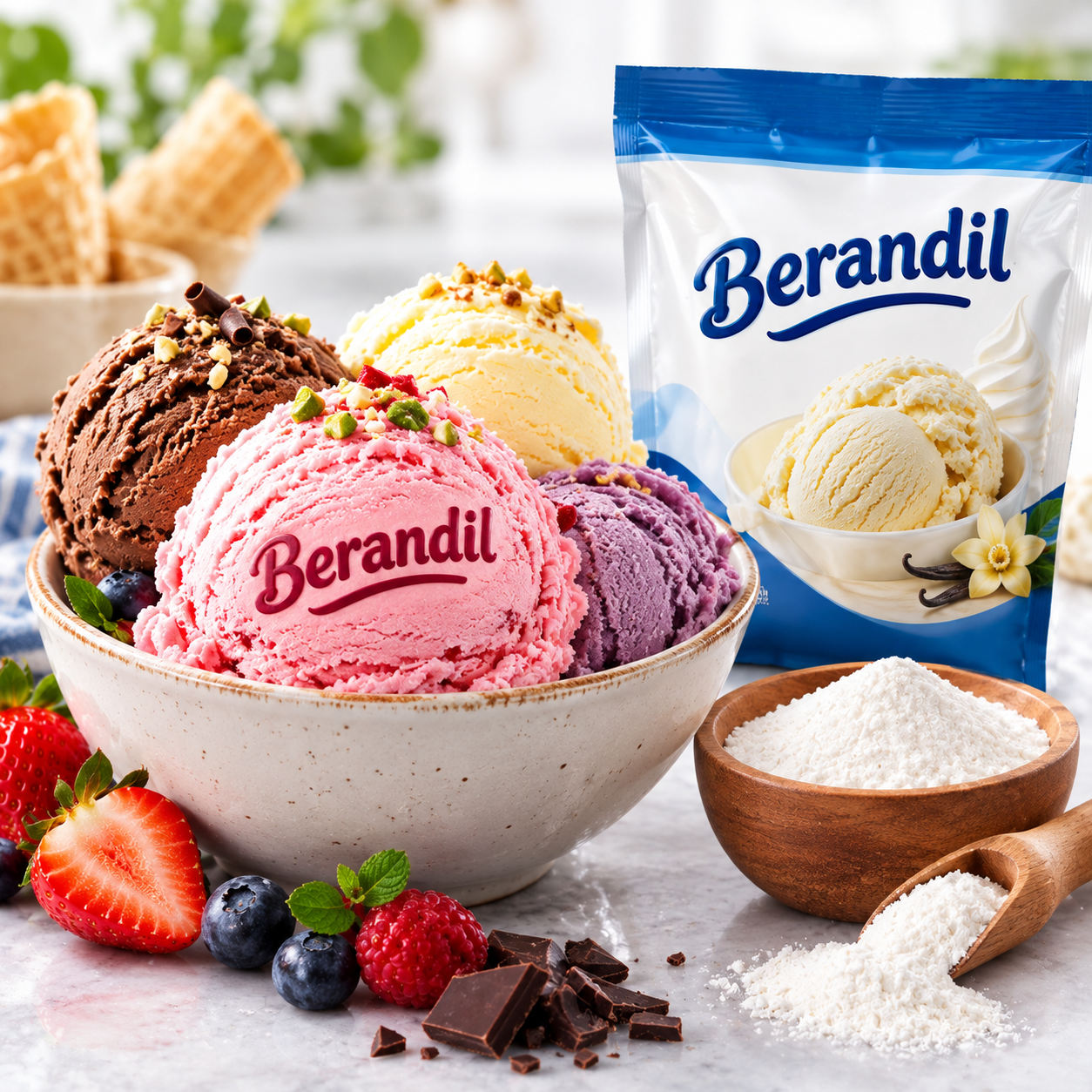
Brandil Ice Cream Stabilizer is a specialized and advanced blend designed for producing ice cream with a smooth, uniform texture and stable structure. With its precise and functional formulation, this product helps improve the physical and sensory properties of ice cream while enhancing the quality of the final product throughout production and storage.
The specialized formulation of this stabilizer is designed to control structure, improve consistency, and create a desirable texture. By helping control the formation of ice crystals, it contributes to a softer and more uniform structure in the final product. Enhanced texture stability and improved resistance to temperature fluctuations are among the other functional benefits of this product.
Brandil Ice Cream Stabilizer is a professional solution for manufacturers seeking premium texture, high stability, consistent quality, and reliable performance. It is designed to meet the needs of professional producers and the standards of competitive international markets.
Enter your order information
Berandil experts are ready to assist you
In addition to providing specialized products for the dairy industry, Brandil strives to make the purchasing process simpler and more professional for manufacturers through reliable delivery, dependable quality, and specialized technical support.
Delivery of products nationwide with proper coordination for fast and reliable order fulfillment.
A strong focus on product quality and providing solutions tailored to the specialized needs of dairy manufacturers.
Receive specialized pre-purchase consultation to select the right product for your production process and technical needs.
A transparent and reliable purchasing process, so you can track your order with confidence and peace of mind.
| Ice Cream Type | Product Code | Usage Dosage | Features and Applications |
|---|---|---|---|
| Traditional Fruit Ice Cream | BF - 008 | 0.3% |
|
| Milk-Based Ice Cream | BM - 005 | 0.3% |
|
| Traditional Milk-Based Ice Cream | BM - 002 | 0.3% |
|
| Water-Based Fruit Ice Cream | BF - 007 | 0.3% |
|
| Ripple Sauce Ice Cream | BR - 009 | 0.3% |
|
An overview of the general application process for an ice cream stabilizer system; from preparing and controlling raw materials and accurately weighing the stabilizer to mixing, hydration, homogenization, heat treatment, cooling, aging and freezing, followed by the final evaluation of ice cream texture, overrun, and stability.
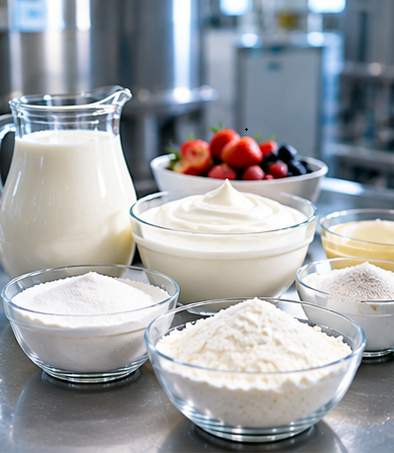 01
First, the raw materials used in ice cream production, including milk, cream, milk solids, sugar, and other ingredients, are prepared according to the product formulation. Proper preparation of the raw materials provides suitable conditions for stabilizer performance and the development of a uniform and stable ice cream texture.
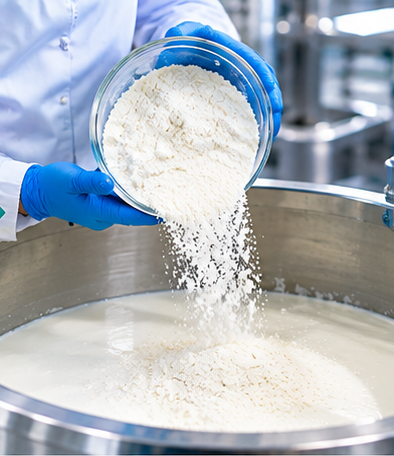 02
The required amount of ice cream stabilizer is determined according to the product type, formulation, total solids, fat content, and desired textural characteristics, and is then accurately weighed. The appropriate stabilizer dosage helps control ice crystals, consistency, melting behavior, and the structural stability of the ice cream.
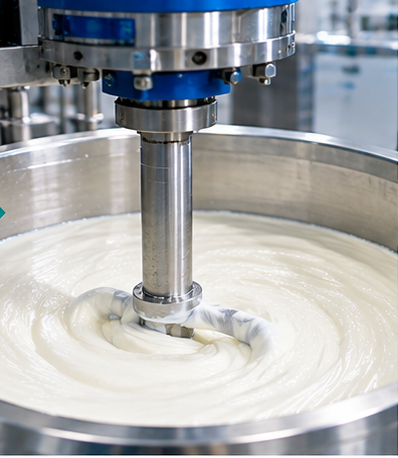 03
The stabilizer is added to the formulation under suitable conditions, and initial mixing is carried out to ensure uniform distribution of the stabilizing system components. Proper stabilizer hydration helps prevent lump formation and provides the conditions required to develop a uniform and stable ice cream structure.
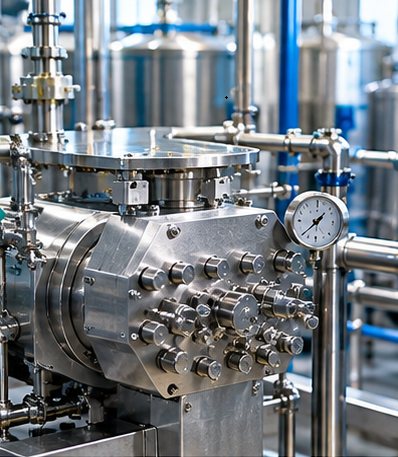 04
After mixing, homogenization is carried out to achieve proper distribution of fat and other formulation components. Proper performance of the stabilizer system at this stage helps create a creamy, uniform, and stable structure while improving the textural characteristics of the ice cream.
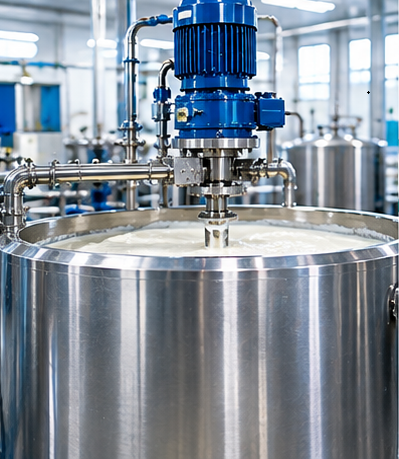 05
Key process parameters, including temperature, time, ingredient addition sequence, mixing intensity, and hydration conditions, are controlled according to the formulation. Precise control of process conditions helps maintain proper stabilizer performance and achieve the desired ice cream texture and stability.
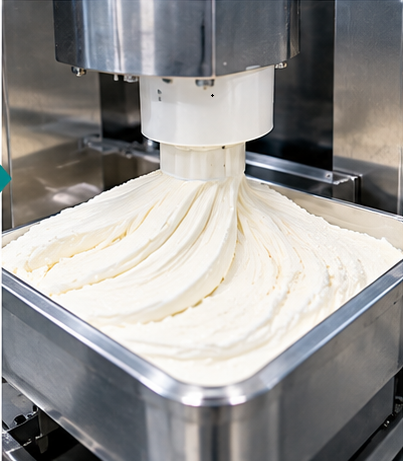 06
The ice cream mix undergoes heat treatment according to the defined process, with temperature and time conditions carefully controlled. Selecting a stabilizer system that is compatible with the heat treatment process helps maintain the structure of the mix and prepare it properly for the cooling and freezing stages.
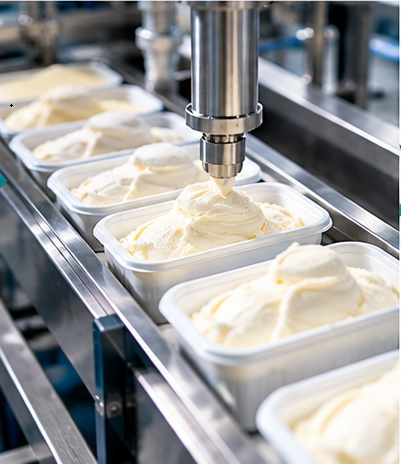 07
After heat treatment, the ice cream mix is cooled under controlled conditions and prepared for the aging stage. During this stage, the structure of the mix develops and the necessary conditions are established for proper texture formation, ice crystal control, and optimal stabilizer performance during freezing.
 08
In the final stage, the ice cream undergoes freezing and is evaluated for texture, consistency, overrun, ice crystal size and stability, melting rate, uniformity, and sensory characteristics. After the product specifications are confirmed, the ice cream is prepared for packaging, hardening, storage, and distribution.
In this section, we answer frequently asked technical questions about ice cream stabilizers, their application in the ice cream production process, texture and consistency control, reducing ice crystal formation, improving resistance to melting, and selecting a stabilizer system appropriate for different types of ice cream.
Ice cream stabilizer is a functional system used to control and improve the physical properties of ice cream. Depending on the product type and formulation, it can help create a uniform texture, achieve appropriate consistency, control free water, reduce ice crystal growth, and improve product stability. In different products such as milk ice cream, fruit ice cream, low-fat ice cream, and industrial ice cream, the functional requirements of the stabilizer vary. The appropriate system should be selected based on the type of ice cream, fat content, solids, protein, sugars, freezing conditions, and storage conditions.
The dosage of ice cream stabilizer is not a fixed amount for all products and depends on the type of ice cream, fat and solids content, sugar composition, water content, protein level, desired texture, and processing conditions. Different ice cream systems may require different usage levels. The final dosage is best determined through laboratory trials and testing under actual production conditions to achieve an appropriate balance between consistency, texture, ice crystal control, melting resistance, and mouthfeel.
By absorbing and managing part of the free water and controlling the structure of the aqueous phase, ice cream stabilizer can affect viscosity, consistency, and the textural properties of the product. Selecting an appropriate stabilizer system can help create a soft, uniform, and creamy texture while reducing the rough mouthfeel caused by undesirable ice crystal growth. The type and amount of stabilizer should be determined according to the target texture, formulation, homogenization process, and freezing conditions so that the final product achieves desirable consistency and mouthfeel.
Ice crystal quality in ice cream is affected by factors such as formulation, water content, the type and amount of sugars, solids, freezing process, and storage conditions. An appropriate stabilizer system can manage free water and increase the viscosity of the continuous phase, helping limit water migration and ice crystal recrystallization while contributing to a softer and more uniform texture. However, ice crystal control does not depend solely on the stabilizer. Freezing rate, storage temperature, temperature fluctuations, and other formulation components should also be considered simultaneously.
Yes, ice cream stabilizer systems can be designed and optimized for industrial applications, but a single system does not necessarily perform identically across all types of ice cream. In industrial ice cream production, factors such as product type, production line capacity, mixing and homogenization equipment, fat and solids content, sugar composition, protein level, freezing rate, and storage conditions should be considered when selecting a stabilizer. Proper stabilizer system design can help improve texture uniformity and maintain consistent product quality during industrial production.
For accurate selection of an ice cream stabilizer, it is helpful to know information such as the type of ice cream, base formulation, fat and solids percentages, sugar content, protein, pH, water content, thermal process, mixing and homogenization equipment, process temperature, freezer type, overrun, and storage conditions. The main product issue should also be clearly identified, such as ice crystal formation, weak texture, rapid melting, rough texture, loss of consistency, shrinkage, or structural changes during storage.
In ice cream, the stabilizer system should be selected according to the goal of creating a soft, delicate, and creamy texture while maintaining appropriate consistency and stability. Free water control, reduced ice crystal growth, appropriate viscosity, improved melting resistance, structural stability during storage, and desirable mouthfeel are important criteria in ice cream stabilizer design. Using an appropriate system can help maintain product texture quality and reduce undesirable changes throughout the storage period.
In ice cream, proper stability of the water and fat systems and the formation of a uniform structure are highly important for achieving the desired texture. An appropriate stabilizer system can help control the aqueous phase, increase mix viscosity, improve the distribution of product components, and reduce the tendency toward separation and structural instability. Alongside the stabilizer, the type of emulsifier, raw material composition, thermal conditions, homogenization intensity, freezing process, and overrun also affect the final performance of the ice cream.
Yes, the stabilizer system can indirectly affect product behavior during aeration, freezing, and melting through its influence on mix viscosity and ice cream structure. However, overrun depends primarily on aeration conditions and the freezing process, and stabilizer performance should be evaluated alongside the emulsifier and other formulation components. Selecting an appropriate system can help maintain ice cream structure during serving and improve resistance to rapid melting, but the extent of its effect depends on the formulation and processing conditions.
Ice cream stabilizer does not directly replace preservatives or food safety and shelf-life control processes. However, controlling free water, reducing ice crystal growth, maintaining texture uniformity, and improving physical stability can help preserve the sensory and structural quality of ice cream during storage. The final shelf life of the product depends on a combination of factors, including formulation, production conditions, freezing process, packaging, cold chain, and storage conditions.
Providing a sample and conducting technical testing can be considered based on the type of ice cream, formulation, and production conditions. For an accurate evaluation of ice cream stabilizer performance, it is recommended to provide the product specifications, production capacity, base formulation, fat and solids percentages, processing equipment, and the existing quality issue. An appropriate sample can then be evaluated under controlled conditions and, where possible, under actual production line conditions to assess its performance in terms of texture, consistency, ice crystal level, melting resistance, overrun, and other desired characteristics.
Brandil experts are ready to review your technical requirements, formulation, and ice cream production process.
Explore technical product information, specifications, benefits, applications, and storage guidelines for ice cream stabilizer used in the formulation of various ice creams, frozen desserts, and frozen dairy products.
Ice cream stabilizer is a specialized functional system used in the formulation of various ice creams and frozen products to help control the formation and growth of ice crystals, improve texture, enhance stability, and create a uniform structure in the product.
Brandil Ice Cream Stabilizer is designed to help create a smooth, uniform, and stable texture, improve mouthfeel, control free water, and maintain product quality throughout the freezing and storage process. This system can be adjusted according to the type of ice cream, fat content, total solids, production process, and desired product characteristics.
The final performance of the stabilizer depends on the formulation composition, type of raw materials, homogenization conditions, pasteurization process, freezing conditions, and product storage conditions.
Ice cream stabilizer is a specialized system designed for use in the formulation of various ice creams, dairy ice cream, fruit ice cream, frozen desserts, and other frozen dairy and non-dairy products. The performance of this system can be adjusted according to the product type, fat content, total solids, type of sweetener, homogenization process, and freezing conditions.
1. Control of Ice Crystal Growth and Improvement of Freeze–Thaw Stability By managing free water and increasing Water Immobilization in the serum phase, the rate of ice crystal growth and Recrystallization during storage is reduced, resulting in a softer, more uniform structure with greater resistance to temperature fluctuations. 2. Optimization of Mix Rheology and Viscosity Development By controlling the rheological properties of the ice cream mix, the system helps create an appropriate Viscosity Profile and improve Flow Behavior, providing more favorable conditions for Homogenization, Ageing, and Freezing. 3. Increased Air Cell Stability and Overrun Control By strengthening the continuous phase structure and increasing the stability of the aerated system, it helps create more uniform Air Cells and reduce Coalescence and Disproportionation, thereby improving product structure and volume development. 4. Improved Meltdown Resistance and Thermal Shock Stability By strengthening the structural network and increasing Water-Binding Capacity, the melting rate of the product is reduced and the ice cream's resistance to Thermal Fluctuations and Thermal Shock is increased; as a result, the product maintains its structure more effectively during distribution and storage. 5. Enhanced Microstructure and Sensory Texture By improving phase distribution and controlling Microstructural Interactions among water, fat, air, and solids, the system helps create a more uniform Texture, higher Creaminess, desirable Body, and softer Mouthfeel, thereby enhancing the sensory quality of the final product.
To maintain the quality and performance of ice cream stabilizer, the product should be stored according to the conditions stated on the packaging and the manufacturer's technical instructions. Protecting the product from moisture, contamination, excessive heat, and unsuitable environmental conditions is important for maintaining the quality of the raw material.
Ice cream stabilizer should be stored in a dry environment and protected from direct contact with moisture to maintain its quality and usability.
Keep the product away from excessive heat, direct light exposure, and unfavorable fluctuations in environmental conditions.
After opening the package, the product should be properly protected and stored according to the manufacturer's instructions.
Always check the production date, expiration date, and storage conditions stated on the ice cream stabilizer packaging.
Exact storage conditions, shelf life, and usage level of ice cream stabilizer must be followed according to the information stated on the product packaging and the manufacturer's technical instructions.
Your review will be displayed on the website after being reviewed by the Berandil team. Your experience with this product regarding performance, texture stability, consistency, syneresis, sliceability, and product quality can be valuable for manufacturers.