
1. Introduction
Yogurt is produced through the fermentation of milk lactose by lactic acid bacteria. During fermentation, the production of lactic acid causes a reduction in pH and changes in the structure of milk proteins, particularly casein. Near the isoelectric point of casein, at a pH of approximately 4.6, interactions between casein micelles increase and a three-dimensional gel network is formed.
In stirred yogurt, unlike set yogurt, the gel formed after fermentation undergoes stirring, smoothing, or homogenization. These operations break the gel structure and convert it into smaller gel particles within a continuous serum phase. Therefore, the structure of stirred yogurt can be considered a type of suspension of protein microgels in the serum phase.
This structure is responsible for properties such as softness, spoonability, appropriate viscosity, and a desirable creamy mouthfeel, but if not properly controlled, it can be susceptible to syneresis. Syneresis is one of the most important quality defects in yogurt and is observed as the accumulation or release of serum on the product surface.
One of the important approaches for controlling this phenomenon is the use of stabilizers.
2. The Concept of Stabilizers and Their Mechanism of Action in Yogurt
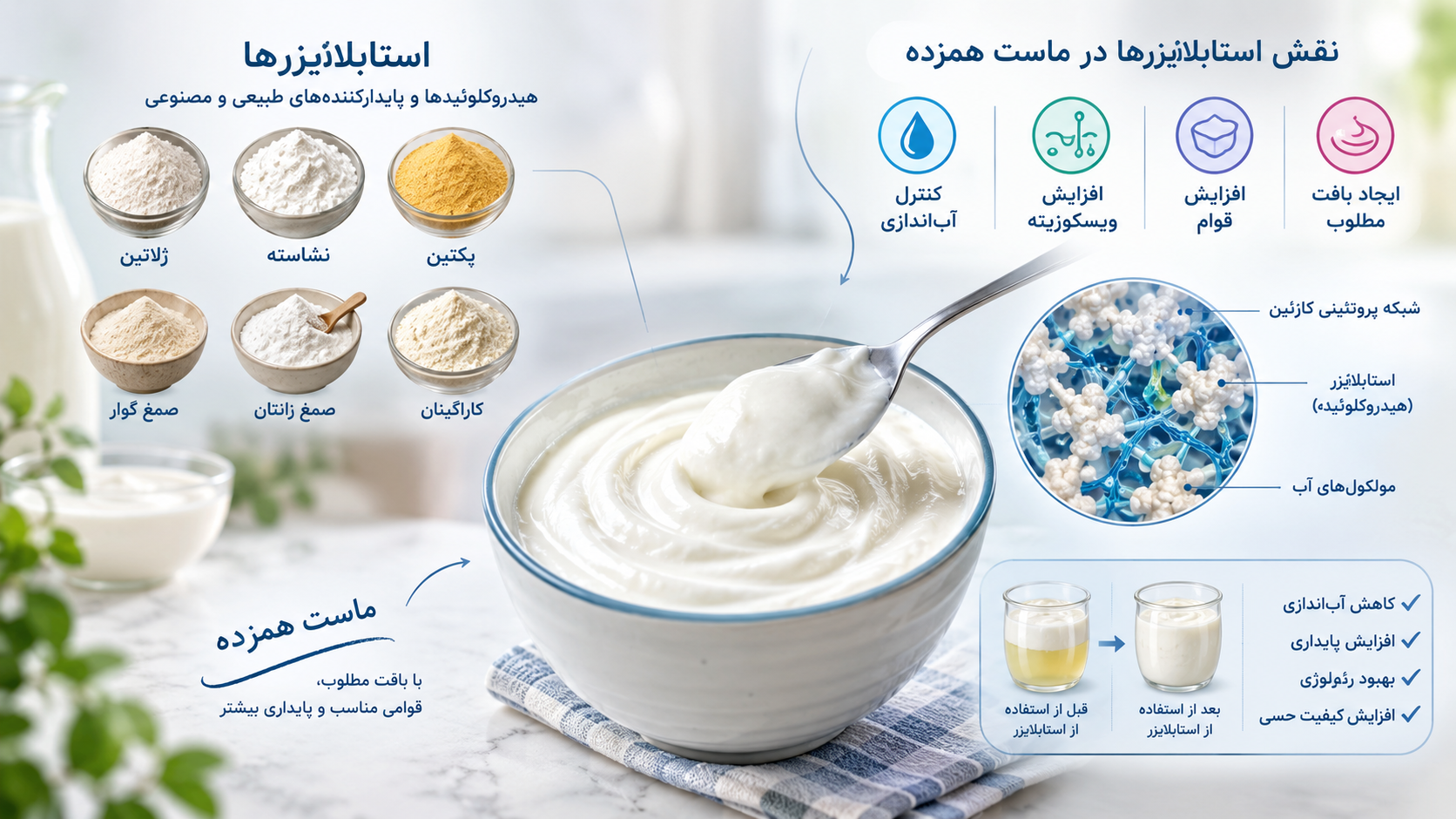
Stabilizers are a group of substances added to food products with the purpose of improving physical stability, controlling free water, increasing consistency, and regulating rheological properties.
In yogurt, many of the stabilizers used belong to the group of hydrocolloids. These compounds are generally polysaccharides or proteins with the ability to absorb or retain water.
The mechanism of action of stabilizers can be divided into several main pathways:
- Increasing water-holding capacity
- Increasing the viscosity of the serum phase
- Strengthening or creating a polymer network
- Interacting with milk proteins
- Reducing the mobility of free water
- Preventing excessive aggregation of gel particles
- Improving structural stability during storage
In fact, the primary purpose of a stabilizer is not necessarily to create an independent gel; rather, in many formulations, the goal is to establish a balance between the casein protein network, serum phase, and added polymer.
3. The Role of Stabilizers in Controlling Syneresis
3-1. Definition of Syneresis
Syneresis refers to the release of the liquid phase from a gel network. In yogurt, this phenomenon is usually observed as serum release and the formation of a liquid layer on the product surface.
The protein network of yogurt can undergo rearrangement and contraction over time. As a result, part of the water contained within the network is released and exits the structure as serum. In stirred yogurt, mechanical processing also disrupts the original gel structure and increases the product's sensitivity to serum separation.
3-2. The Role of Stabilizers in Reducing Syneresis
Stabilizers reduce serum release by increasing water binding and decreasing the amount of free water. Increasing the viscosity of the continuous phase also reduces water movement within the product.
For example, gelatin, starch, and certain gums can retain water within the product matrix by creating hydrophilic structures.
However, not all hydrocolloids have the same effect. Studies have shown that the type and concentration of a hydrocolloid can create significant differences in syneresis. For example, in a comparative study, gelatin was able to reduce syneresis while simultaneously increasing the consistency and viscosity of low-fat yogurt, whereas some treatments containing xanthan and carrageenan increased viscosity and strength but, under certain conditions, resulted in increased syneresis and undesirable mouthfeel.
4. The Role of Stabilizers in Increasing Viscosity
Viscosity is one of the most important quality indicators in stirred yogurt. A product with very low viscosity generally feels watery and thin, while excessive viscosity can produce a heavy, sticky, or unnatural product.
Hydrocolloids increase the product's resistance to flow by increasing the viscosity of the serum phase. This effect depends on factors such as:
- the molecular weight of the hydrocolloid;
- concentration;
- degree of hydrophilicity;
- molecular structure;
- temperature;
- pH;
- the presence of salts and proteins;
- and interactions between the hydrocolloid and milk components
For example, xanthan gum and guar gum have attracted attention because of their high viscosity-enhancing capacity, even at relatively low concentrations. In one study, the use of xanthan and guar improved viscosity, water-holding capacity, and yogurt texture, and under the study conditions, xanthan at a concentration of 0.5% showed suitable performance in reducing syneresis.
5. The Effect of Stabilizers on Yogurt Consistency and Strength
Yogurt consistency is the result of complex interactions between the protein structure, total solids, fat, water, and hydrocolloid compounds.
Adding a stabilizer can:
- increase gel strength;
- improve water-holding capacity;
- stabilize the structure of gel particles;
- increase viscosity;
- and enhance the perception of thickness and consistency.
However, an excessive increase in consistency does not necessarily indicate higher quality. For example, research on starch in stirred yogurt has shown that increasing the starch phase can initially increase viscosity, elastic modulus, and properties such as thickness and strength, but at higher levels it may create an excessively sticky and elastic texture.
Therefore, the optimum stabilizer concentration is highly important.
6. The Effect of Stabilizers on Desired Texture
From the consumer's perspective, yogurt texture includes a range of characteristics, including:
- firmness;
- softness;
- creaminess;
- thickness;
- uniformity;
- stickiness;
- spoonability;
- and mouthfeel.
The microscopic structure of yogurt is directly related to these characteristics. In stirred yogurt, the size, shape, aggregation, and compactness of protein microgels, as well as the properties of the serum phase, affect texture and rheological behavior.
An appropriate stabilizer should strengthen the structure without creating an artificial or gel-like sensation.
7. Reviewing the Role of Major Stabilizer Types
7-1. Gelatin
Gelatin is a protein-based hydrocolloid with the ability to form gels and bind water.
In yogurt, gelatin can:
- reduce syneresis;
- increase viscosity;
- increase gel strength;
- improve texture;
- and create a creamy and smooth mouthfeel.
Comparative studies have shown that gelatin can have a significant effect in low-fat yogurt by reducing syneresis and improving texture and viscosity properties.
7-2. Starch
Starch is one of the most widely used thickening agents in the food industry. In yogurt, starch can increase viscosity and consistency through water absorption and granule swelling.
The advantages of starch include:
- increased thickness;
- increased viscosity;
- improved texture;
- reduced free water;
- and relatively low cost.
However, excessive starch can result in an overly sticky, heavy, or elastic texture. Structural studies indicate that increasing the starch phase up to a certain range improves physical and sensory properties, but after exceeding the optimum level, texture quality may decrease.
7-3. Pectin
Pectin is a plant-based polysaccharide used in dairy products because of its ability to interact with water and certain milk components.
Pectin can contribute to:
- controlling syneresis;
- increasing consistency;
- increasing viscosity;
- and creating a uniform structure.
However, its performance depends on the type of pectin, degree of esterification, pH, and product composition.
Some studies have shown that anionic stabilizers such as pectin and carrageenan may have undesirable effects on texture and sensory acceptance in certain yogurt formulations; therefore, their use should be determined according to the formulation conditions.
7-4. Guar Gum
Guar gum is a polysaccharide with a high viscosity-enhancing capacity.
Its main effects include:
- increasing viscosity;
- increasing consistency;
- increasing water-holding capacity;
- reducing movement of the serum phase;
- and improving physical stability.
When used in excessive amounts, guar gum may produce a product that is excessively thick and sticky.
7-5. Xanthan Gum
Xanthan has attracted attention in dairy product formulations because of its viscosity-enhancing capacity and suitable stability across a wide range of pH and temperature conditions.
In yogurt, it can lead to:
- increased viscosity;
- increased water-holding capacity;
- improved consistency;
- and reduced serum separation.
However, as with other hydrocolloids, excessive use may result in an unnatural texture and undesirable mouthfeel.
7-6. Carrageenan
Carrageenan is a sulfated polysaccharide capable of creating structure and increasing consistency.
This compound can interact with milk proteins and affect gel structure. However, as with other hydrocolloids, increasing viscosity or strength alone is not a sufficient criterion for selecting carrageenan, because increasing its level in some formulations may have undesirable effects on syneresis and sensory properties.
8. Comparing the Performance of Different Stabilizers
| Stabilizer | Viscosity Increase | Syneresis Control | Consistency Increase | Effect on Texture |
|---|---|---|---|---|
| Gelatin | Soft and creamy | |||
| Starch | Thick and dense | |||
| Guar Gum | May become sticky | |||
| Xanthan | May become slightly sticky | |||
| Pectin | Relatively uniform | |||
| Carrageenan | May become gel-like |
This table represents a qualitative comparison, and the actual performance of each stabilizer depends on the type of material, purity level, concentration, milk composition, pH, thermal treatment, and processing conditions.
9. The Importance of Combining Multiple Stabilizers
One of the important approaches in the dairy industry is the use of blended stabilizer systems.
This is because each stabilizer has a different performance profile. For example, a formulation may contain:
- an ingredient for binding water,
- an ingredient for increasing viscosity,
- and an ingredient for strengthening the structure
In this way, better performance can be achieved with a lower amount of each individual ingredient.
Recent studies have also emphasized the importance of examining hydrocolloid combinations and their synergistic effects, because selecting a single hydrocolloid is not always the best approach for achieving the desired rheological, textural, and sensory properties simultaneously.
10. The Relationship Between Stabilizers and Processing Conditions
Stabilizer performance cannot be evaluated independently of the yogurt production process.
10-1. Thermal Treatment
Increasing the intensity of thermal treatment of milk can increase whey protein denaturation and its interaction with casein, thereby affecting viscosity, strength, and syneresis. Under certain conditions, more intensive thermal treatment is associated with increased viscosity and reduced syneresis.
10-2. Homogenization
Proper homogenization can reduce fat globule size and affect the final gel structure.
10-3. Stirring
Stirring is essential for producing stirred yogurt, but excessive mechanical stress can disrupt the gel network more than necessary.
10-4. Smoothing and Cooling Temperature
The processing temperature after fermentation is also highly important. Studies have shown that smoothing temperature and cooling conditions can significantly affect viscosity, consistency, and syneresis in stirred yogurt.
Therefore, even the best stabilizer system may not necessarily produce a desirable product when used together with inappropriate processing conditions.
11. The Relationship Between Milk Protein and Stabilizers
An important point in yogurt formulation design is that a stabilizer should not be considered a complete substitute for protein.
Increasing milk solids, protein, and fat generally contributes to increased viscosity and water-holding capacity. Changing the ratio of casein to whey protein can also affect gel structure and properties.
Therefore, an appropriate formulation should achieve a balance between:
to achieve the desired balance.
12. Stabilizers in Low-Fat Yogurt Production
Stabilizers are particularly important in low-fat yogurt because removing part of the fat can reduce creamy mouthfeel, decrease thickness, and alter texture properties.
Under these conditions, hydrocolloids can compensate for part of the physical role of fat through:
- increasing viscosity;
- increasing thickness;
- improving oral lubrication;
- increasing water retention within the structure;
- and reducing syneresis.
For this reason, gelatin, starch, and other hydrocolloids are particularly important in the development of low-fat yogurts.
13. Limitations and Drawbacks of Stabilizer Use
Although the use of stabilizers can improve yogurt quality, inappropriate use can cause problems.
The main potential problems include:
- formation of a gel-like texture;
- excessive stickiness;
- a slimy mouthfeel;
- formation of grains or lumps;
- reduced naturalness of texture;
- undesirable taste or odor in some formulations;
- excessive viscosity;
- and reduced sensory acceptance.
Some consumers also prefer products with simpler labels and fewer additives; therefore, using the minimum effective stabilizer level becomes important from both formulation and marketing perspectives.
14. Conclusion
Stabilizers are important tools for controlling the physical and rheological quality of stirred yogurt. Through increasing water-holding capacity, increasing the viscosity of the continuous phase, creating or strengthening the polymeric structure, and interacting with milk components, these compounds can reduce syneresis and improve the consistency and texture of the product.
However, no stabilizer can be considered the universally best option for all types of yogurt. The performance of each material depends on its type and concentration, milk composition, protein and total solids levels, thermal treatment, fermentation conditions, stirring intensity, processing temperature, and storage conditions.
Research evidence indicates that gelatin can simultaneously reduce syneresis and improve texture and viscosity properties in some formulations, while starch primarily acts as a thickening and viscosity-enhancing agent. Guar gum and xanthan gum also have a high capacity for increasing viscosity and water retention, but excessive amounts may create undesirable texture.
Pectin and carrageenan can also be used to control structure because of their ability to interact with milk components, but selecting the appropriate level is essential.
Ultimately, the scientific approach to producing high-quality stirred yogurt is the simultaneous optimization of formulation and process, so that the final product has appropriate viscosity and consistency, minimal syneresis, a uniform structure, a creamy mouthfeel, and desirable stability during storage.
Recent research is also moving toward more targeted use of hydrocolloids, multi-component formulations, and a more precise understanding of the relationship between microstructure and the sensory and rheological properties of yogurt.
Selected References
- Hydrocolloid application in yogurt: Progress, challenges and future trends, Food Hydrocolloids, 2024.
- Studying stirred yogurt microstructure and its correlation to physical properties: A review, Food Hydrocolloids, 2021.
- Effect of different hydrocolloids on texture, rheology, tribology and sensory perception of texture and mouthfeel of low-fat pot-set yoghurt, Food Hydrocolloids.
- Starch swelling behavior and texture development in stirred yogurt, Food Hydrocolloids, 2020.
- Industrial Yogurt Manufacture: Monitoring of Fermentation Process and Improvement of Final Product Quality, Journal of Dairy Science, 2007.
- Relationship between smoothing temperature, storage time, syneresis and rheological properties of stirred yogurt, International Dairy Journal, 2020.
- The role of exopolysaccharide-producing cultures and whey protein ingredients in yoghurt, International Dairy Journal.